

Taxes are going up.
First Rachel Reeves and now, it seems likely, John Healey. We all want good public services – not least armed forces actually able to defend us. We all want a properly-funded NHS (as I know only too well). But we also know that if you hike taxes to pay for it all, you risk killing off growth. One small example: there are around 200,000 fewer payroll jobs in the UK since the 2024 rise in employers National Insurance was announced.
Faced with a straight trade-off between public services and economic growth, we know what this government will choose. But do we have to make that choice? Looking at other countries, the evidence suggests you can, in fact, have decent public services and decent growth – just not the way we go about it in Britain. It’s something I devote a chapter to in my new book Can We Be Rich Again? The Surprising Potential of Britain’s Economy.
First of all, the data is pretty clear about the link between higher tax and lower growth. When I was Chancellor, I asked officials at the Treasury to look into the issue in detail. The advice I got was straightforward: whatever basket of countries you took – G7, G20, Europe or the OECD – those with lower tax levels had, on average, higher growth. They added, however, that economists don’t agree whether it is correlation or causation e.g. whether high tax levels cause lower growth or high growth enables lower tax.
I strongly believe it is the former (high tax causes lower growth), as I will explain. But it’s important to acknowledge that not all public spending is bad for growth. Money spent on infrastructure such as new roads or railways can boost productivity, making individuals and companies more efficient. Public investment in nuclear power can bring down energy prices for offices and factories. Education spending boosts human capital. But not all spending boosts productivity: above-inflation public sector pay rises or parking large chunks of the population on welfare can do the opposite. Many Scandinavian countries that are more prosperous than us – despite higher taxes – are much more disciplined at directing government spending into areas that boost economic growth. They have better infrastructure and often tougher rules requiring welfare recipients to work. Denmark gets 60% of disabled adults into work compared to 53% in Britain.1
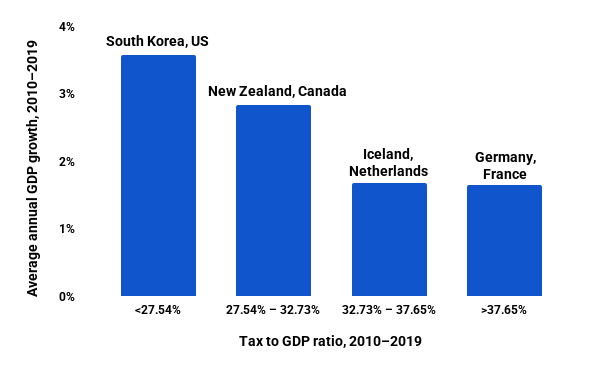
And there’s another problem with the Scandinavian model. Even prosperous countries seem to get stuck in a low growth trap when the state gets too big. In my book I look at data from all the 38 OECD-member advanced economies between 2010 and 2019. I cross-referenced their growth rate against overall levels of tax as a proportion of GDP. Countries in the lowest tax quartile, such as Australia, the US and South Korea, grew on average 2% a year faster than those in the highest tax quartile, such as Germany, France and Italy.2 The UK is in the middle of the pack although heading towards the higher tax quartile (something for which I was partly responsible). Similar analysis over a longer timescale comes to the same conclusion Jon Moynihan’s excellent book Return to Growth.
For anyone like me who has run a business, the reason is obvious. Growth depends on investment – and businesses invest more when taxes take less of their profits. Conversely, when taxes are higher, businesses make less profit and cut back investment. Angela Merkel once famously said that Europe has 7% of the world’s population, 25% of its GDP and 50% of its social spending. The inevitable result of such a choice is higher taxes, lower investment and lower growth.
But crucially the reverse is also true: lower taxation means more investment and therefore more growth. This happened after tax cuts in Denmark (2009), in Sweden (1991) and in the UK (sadly a long way back in 1988). The result is a larger private sector and one better able to support the spending needed by the state – a virtuous circle rather than the UK’s vicious one. In the US, the cost of every public sector worker is funded by the taxes of six private sector workers. In Britain, with our relatively smaller private sector, it’s just five. But that burden falls if the private sector grows. And the role of tax cuts in supporting growth is not just a centre-right view. The studiously independent OBR (loathed equally by Labour and Conservative governments) said that even my limited tax cuts in 2023/24 (including 4p off employees National Insurance) would grow the economy by 0.4%, creating the equivalent of 200,000 more jobs.
The most influential analysis of the link between growth and tax levels was done a while back by US economist Robert Barro. He was one of the first economists to explain how, when governments spend more, business investment falls – leading to lower growth. Economists call this ‘crowding out’. Barro was careful to say that not all government spending is bad for growth – particularly capital spending on infrastructure or investment in education. But he said that, after a certain point, a bigger state simply means lower growth. Back to the OBR again: they said Labour’s recent tax increases ‘deliver a temporary boost to GDP in the near term and some crowding out of private activity in the medium term’. In other words they agree with Barro that higher taxes can mean less investment and therefore lower growth.
But it isn’t just crowding out – higher taxes damage what John Maynard Keynes called ‘animal spirits’ upon which capitalism depends. Without the entrepreneurial drive that persuades people to take risks, start a business and generally work hard, no economy can prosper. Nobel prizewinner Joel Mokyr noted the link between human attitudes and economic dynamism. The right culture – personal responsibility and reward for risk and effort – makes a big difference.
So, back to the public services conundrum. If you accept what the economists above say, how do we keep the country safe and pay for the NHS without damaging tax rises?
In the longer term, the answer is obviously to secure economic growth. An increase of just 1% in GDP leads to higher tax receipts, of around £10–12 billion each year, all available to for public services. If you are patient, you can have your cake and eat it. Indeed, countries like Switzerland, Japan and Singapore show that you don’t need to make a choice between low taxes or decent public services – it’s perfectly possible to have both. But spending on public services must come after economic growth rather than being introduced before it – and at a scale that stifles it.
The problem is that takes time which we don’t have. NATO Secretary-General Mark Rutte says Putin could attack a NATO country within three to seven years. Increasing funding for defence right now – without damaging tax rises – means finding savings from other budgets. For that, there is only one credible option: welfare reform. Whether for taxpayers, the national finances or the highly vulnerable individuals involved, it cannot be right that every day we sign off 1,000 more people as not having to look for work and 700 more people onto disability benefit.3 Yet those are the numbers broadly baked into government spending projections for the current fiscal period. Most of the issues in our welfare system date from the pandemic. If we introduced reforms that reduced the cost of working age welfare to pre-pandemic 2019 levels, we would save £58 billion a year by the end of a five year fiscal period. That’s more than enough to find extra money for the NHS and defence. We could even reverse some of the tax rises that have been so damaging to growth.
Not easy politically, of course, for a Labour government. But sometimes I think politicians underestimate voters. They know perfectly well the challenges and tradeoffs we face. And they will repay in spades any politician courageous enough to confront our high tax, low growth trap.
PS In the article I acknowledge that I put up taxes when I was Chancellor, something which may seem to go against the central argument of this article. The reason is twofold: debt was higher, after borrowing £350 billion to get us through the pandemic, and interest rates were higher partly because of the inflation spike set off by the invasion of Ukraine. Balancing the books has to be the starting point for any journey to lower taxes as even Donald Trump is starting to find out.
There is no charge for my fortnightly email but if you’ve enjoyed it, please hit the ‘Restack’ and ‘Like’’ buttons below. It helps more people see it.
Calculations based on data published by Eurostat and the ONS.
Author’s calculations using data from the IMF and OECD.
Based on DWP statistics on LCWRA decisions and PIP caseload.
Dear Jeremy,
You are correct that was an argument pushed by the vested interests, and it is true that the flight paths of the two major airports would have to be co-ordinated but in no way a real barrier. PB
Enlightening and very interesting.